Arch Enemies Forever is a dark fantasy arena prototype for free for all and two versus two. Playtest 0.6.2 takes place indoors, in a modular dungeon centered on a Grand Hall. First person is the default; V switches to third person. Matches go to four round victories, with persistent loot and character progression between depths.
0.6.2: equipment, loot and deeper talents
Each round now generates a new seeded modular layout. Everyone shares the same rooms, collision and routes, with room dimensions and optional annex loops varying between depths. The large central hall, protected starts, connected passages and upper gallery remain the structure around which those variations are assembled.
Loot must be taken deliberately. Press F near a drop to open its loot window; choose Take or Take All. Walking over rewards collects nothing. Weapon damage breaks vases and crates into finite gold and small supplies, including potions, caltrops and ward scrolls. Chest and remains rewards also stay in the world until claimed. Packed supplies occupy one backpack cell when the belt is full; double click or drag them into an empty belt slot. Drag a backpack item onto clear world space to drop that exact item with its rolls preserved.
The equipment panel places the actual equipped character between its slots. Cloth, leather, mail and plate now have distinct silhouettes and item artwork. Item hovers show quality, armor, weapon timing, rolled attributes and unmet requirements; a red border marks gear whose attribute requirements are not met. This remains an early playtest, with presentation and interaction checks supporting further hands-on testing.
Rooms, passages and a second floor
The indoor assembly uses reusable room, corridor, stair and gallery modules. A Grand Hall connects large chambers, protected spawn rooms and small closets through narrow, medium and wide passages; some seeds add connected annex rooms. Four staircases lead to a walkable upper gallery with safety rails. Opaque ceilings, photographic stone surfaces, hanging fire bowls and wall lights replace the earlier open sky.
Skeletons, giant rats, spiders and bats defend routes and loot. Spike and poison traps give a warning before activating. Four processional doors change real collision and navigation when opened. The layout uses the same physical geometry on the dedicated server and the client, with matched routes around its four quarters.
Hold F for three seconds to open a door or chest; a radial meter surrounds the crosshair. You must remain grounded and still. Releasing the key, moving, jumping, taking damage or using an action interrupts the interaction. Four chamber caches and a central reliquary open once per round. The central chest guarantees Rare-or-better gear rolls. Defeated players leave remains that take two seconds to search and produce fresh bonus loot without taking or copying the inventory their owner keeps. Container drops are finite.
Weapons and spells follow your equipment
Any class can use found weapons. Swords, axes and single daggers have their own reach and committed attack motion; an equipped offhand dagger enables dual wielding. Sword and dagger loadouts can use a shield. Bows and heavy crossbows aim with held right click instead of blocking. Aiming improves accuracy while slowing movement.
Arcane, Ember and Grove staffs each carry two selectable spells. Wands fire their innate minor spell with left click: add a tome for three secondary choices, or a shield for its fixed protective spell. A bare wand has no secondary spell. Hold Q, point at a spell and release to select it; right click casts the selection. Mana costs, cast preparation and independent spell cooldowns limit repeated casting.
Equip one main hand and one compatible offhand. Two-handed staffs, bows, crossbows and axes occupy both hands. Hold Tab and equip a replacement from the backpack to change weapons; hand changes use a committed 0.9-second animation. There are no R/E weapon-set swaps. Offhand compatibility and armor requirements are validated before a change can complete.
Four class abilities and three talent trees
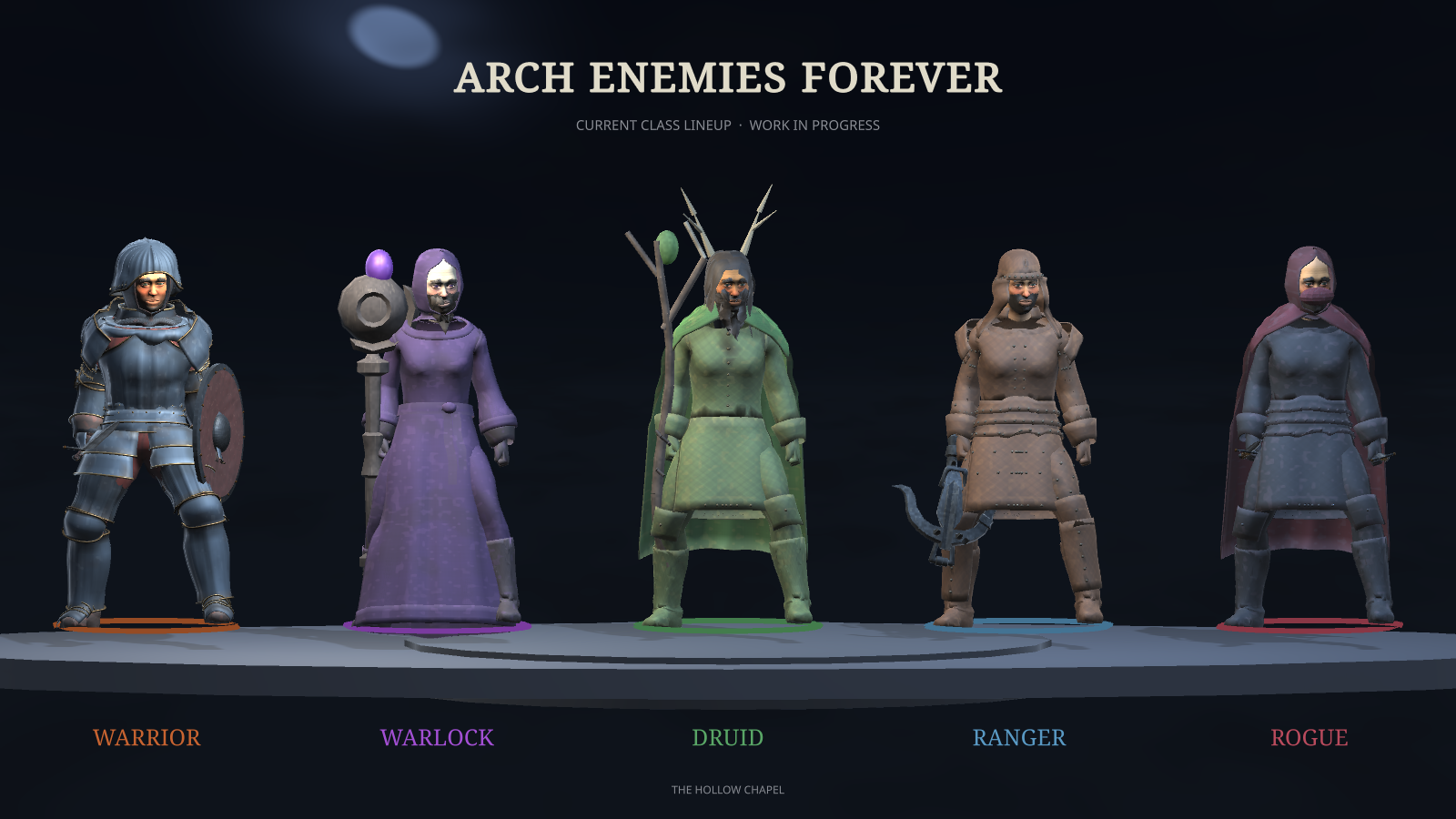
Choose Warrior, Warlock, Druid, Ranger or Rogue. Each keeps four class actions alongside its weapons: Shift movement, Z and X utilities, and a charged ultimate on C. The spell wheel uses Q independently of those class actions.
Each class has three seven-tier talent trees with eighteen talents per tree. Every completed round grants twelve talent points, alongside five basic attribute points. Each rank costs one point. A deeper tier requires five more points invested in its tree, and connected talents require the linked parent ranks. The full tree view shows all fifty-four nodes, ranks and prerequisites; points can be spent across different trees. Progression persists during the match and resets for a new match.
- Warrior: Duelist, Berserker and Bulwark.
- Warlock: Affliction, Bloodcraft and Demonology.
- Druid: Feral, Thorns and Grove.
- Ranger: Marksman, Skirmisher and Trapper.
- Rogue: Assassin, Duelist and Venom.
The nodes affect actual attacks, protection, movement, healing, poison, control or class abilities. The interface shows descriptions, prerequisites, current ranks and unspent points. Attributes and talents persist into the next depth; a new match resets progression.
Keep and equip your spoils
Wear a helmet, chest piece, leggings, boots, belt and bracers alongside a trinket, two rings and a necklace. Rolled attributes remain attached to each unique item. Cloth, Leather, Mail and Plate have different armor values and requirements. Requirements use allocated attributes plus other equipped items; an item cannot satisfy its own requirement. Armor is not locked to a class.
The backpack starts as a ten-by-six grid. Weapons and larger armor occupy several cells. Found or purchased bags add rows, up to ten; Auto Sort packs the grid without changing worn equipment. Drag an item onto a compatible equipment slot or double click to use its suggested slot. Invalid changes leave the item in place and explain what blocked them.
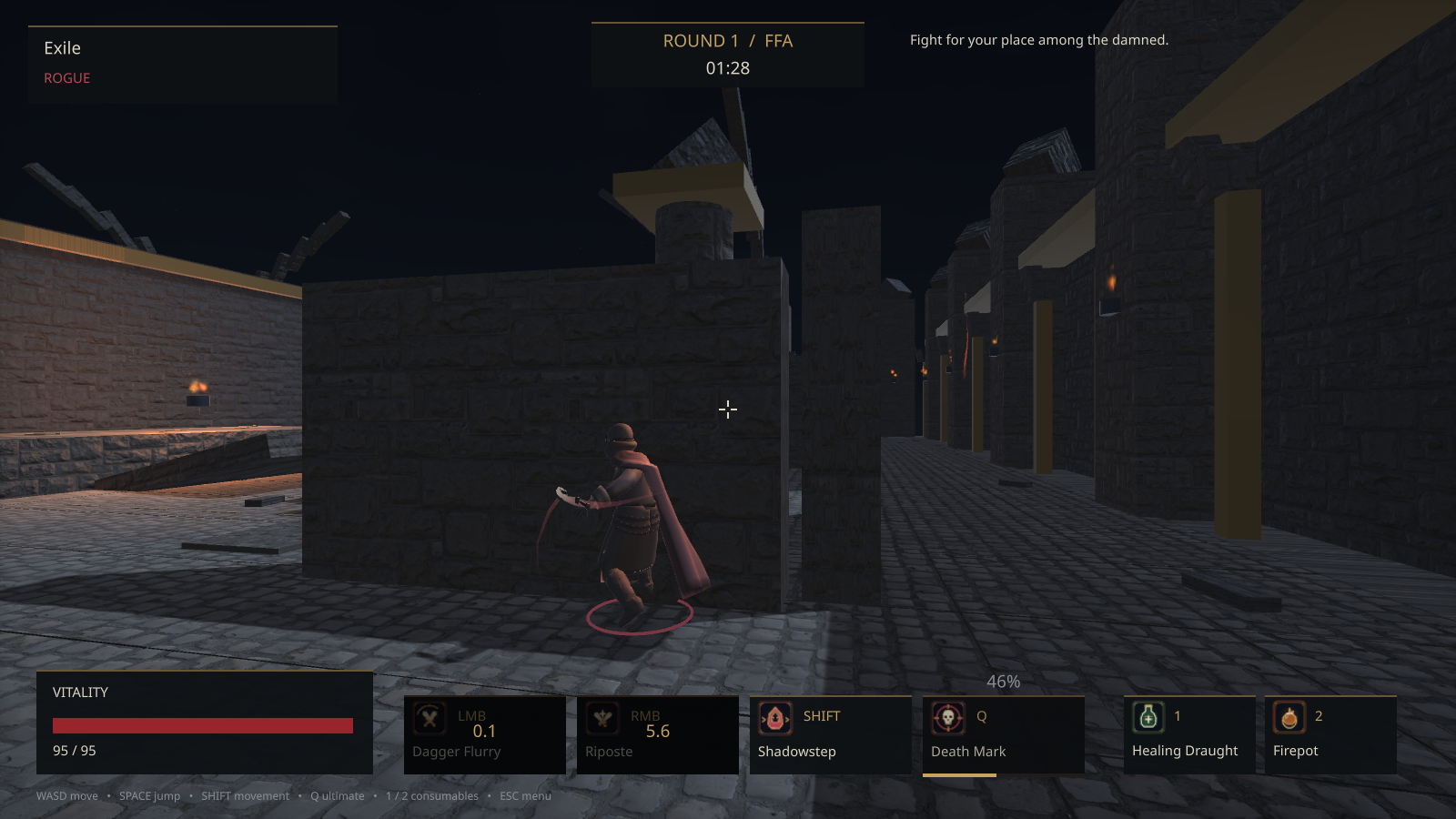
Hold Tab to open the inventory during a round; release it to close. Equipment and backpack docks leave the center of the world visible. You can keep moving and jumping while it is open; right-drag through the gap to look. Combat continues. The compact HUD uses bottom-left resource bars, centered weapon/class/item actions, a 2v2 ally panel and a circular minimap with explored-area fog.
Each round awards 60 gold, with 20 extra gold and a 15% merchant discount for defeated players. Everyone can trade between depths. Buy rolled gear, sell unwanted items, upgrade equipment or expand the pack, then ready up. The readiness list shows who is still preparing. Two consumable belt slots use 1 and 2; supplies can be collected by every class and unused supplies persist.
Rounds retain a four-minute limit. The Hollow starts closing after two and a half minutes and reaches its final radius 75 seconds later; elimination may finish a round sooner. Automated bot observations are useful for finding pursuit failures, but do not establish human round duration or competitive balance.
Download the playtest
The Windows and Linux launchers install updates and verify or repair files using signed release metadata. Linux uses its native launcher to run the Windows game through Steam Proton.
- Windows launcher installer
- Windows portable launcher
- Linux launcher — extract and run
./install.sh. - Full Windows game ZIP — extract everything and open
ArchEnemiesForever.exe. Use the launcher for automatic updates. - Download checksums
Linux needs Steam, Proton and its matching Steam Linux Runtime. Choose Install / Update, then Play. Local practice with bots is available from the menu. Multiplayer uses a dedicated home server; ask the host for its access code and update to the matching playtest build.
Controls: WASD moves, mouse aims, LMB attacks, RMB blocks, aims or casts according to equipment, Q selects staff/tome spells, Shift/Z/X/C use class actions, F opens nearby loot or holds a container interaction, 1/2 use supplies, Space jumps, held Tab opens inventory, P shows the scoreboard, V changes view, Alt inspects tooltips and Escape opens the menu.
Free and owned artwork
Character bases and clothing use Humans by Daniel Gruginski, a CC0 pack based on MakeHuman / MPFB with AI-assisted generation tools. Humanoid animation uses Quaternius’s Universal Animation Library, also CC0. Additional free KayKit and Quaternius parts are credited in the build. Photographic stone surfaces come from Poly Haven.
The interface incorporates Classic RPG GUI and Basic RPG Icons by PONETI, already owned by the project owner. Rogue veil particles use a smoke mask from the owned POLYGON - Particle FX Pack by Synty Studios. These licensed works remain their creators’ artwork; source asset packages are not distributed with the game. The arena geometry, procedural foliage, layered fire setup, generic loot props, accessory icon renders, weapon tools, and game code were developed with AI assistance.
Recorded effects include CC0 sounds by Kenney, EZduzziteh, and Julie Damsgaard / Spring Spring. The score blends ominous ambience into battle music as combat approaches.
Music: “Maleficus” and “Legionnaire (Original)” by Scott Buckley — released under CC BY 4.0. www.scottbuckley.com.au. Edited into loops and dynamically mixed for the game.
This is an early playable prototype developed with AI assistance. Focused authority checks, module/navigation checks, staged interface reviews and separate automated match and transport flows support the playtest; they do not replace human balance or performance testing. Full artwork, font and music credits are included in the download.